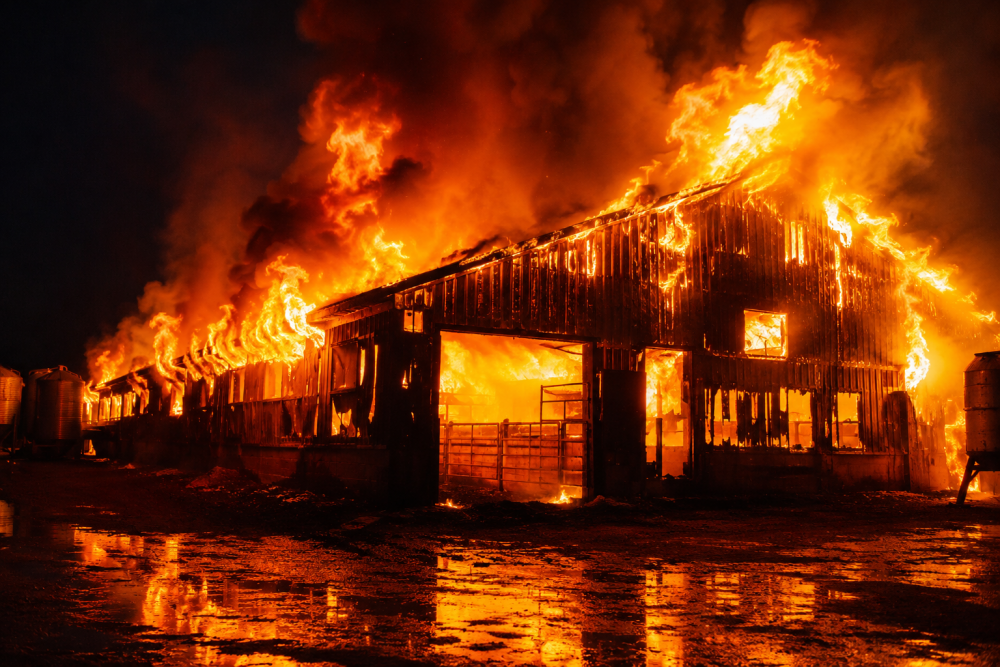
ANOTHER EXAMPLE OF HOW LITTLE ANIMALS TRULY MATTER IN THIS PROVINCE
CBC News – 14 July 2026:
https://www.cbc.ca/news/canada/london/hog-barn-fire-simcoe-9.7269975
2025 Statistics have not been released yet…
But based on the reported incidents that we could locate, 2025 was sadly another significant year for barn fires involving livestock in Ontario.
In 2024, there were 125 barn fires in Ontario...
Historically, according to the office of the Provincial Fire Marshal, Ontario averages about 80 livestock barn fires per year. Unfortunately they do not track or publish province wide animal death tolls.
Despite these horrific numbers, there is no general requirement that existing livestock barns have automatic sprinkler systems or smoke detection systems.
Many farm buildings are also exempt from large portions of the Ontario Fire Code because of their agricultural use. The truth – Ontario’s building code and fire regulations are mainly meant for human life – not livestock. Since farm buildings are classified as “low human occupancy” the fire regulations are extremely lax.
THE TRUTH: It comes down to money… Doesn’t it always?
Governments and the agriculture industry have resisted making sprinkler/fire suppression systems mandatory because of the so-called “undo hardship” it would place on farmers.
Sadly, Ontario has a shameful practice of tossing aside humane treatment of animals if it means keeping the agricultural sector happy.
Why? Statistics clearly show that people involved in the agriculture sector and the hunter/angler areas historically lean heavily Progressive Conservative.
One recurring concern identified by the Ontario Office of the Fire Marshall is that roughly 40-50% of barn fires result in total destruction of the structure; making it impossible to determine the cause.
The leading cause of barn fires is:
- Electrical or mechanical failure
- Improper handling/storing of combustible materials
Fire safety organizations are increasingly recommending:
- Automatic sprinkler systems in large livestock barns.
- Smoke and heat detection linked to remote monitoring.
- Fire compartmentation to slow fire spread.
- Backup power for ventilation systems.
- Regular thermal imaging of electrical equipment.
- Annual electrical inspections.
These measures are viewed as particularly important because modern livestock barns may house thousands or even tens of thousands of animals, making evacuation virtually impossible once a fire becomes well established.
THUS FAR, THE GOVERNMENT OF ONTARIO HAS RESISTED SUCH FIRE SAFETY RECOMMENDATIONS.
Some of the major reported livestock barn fires in Ontario thus far in 2026 and during 2025 included:
- Brantford (January 2026): Over 20,000 hogs were killed in a fire at a large commercial hog operation.
- Uxbridge (June 2026): Large fire at a livestock farm – large number of animals perished, total not released
- Norfolk (July 2026): At least 20,000 hogs were lost in early morning fire
- Norfolk County (October 2025): Approximately 20,000 pigs died in a massive hog barn fire. This was one of the largest livestock losses in Canada in recent years.
- North Frontenac (November 2025): A suspicious barn fire was investigated by the OPP. Public reports did not indicate significant livestock losses.
- There are many smaller barn fires involving cattle, horses, poultry, and sheep were reported across the province but these seldom garner media coverage.
PLEASE HELP BRING ABOUT MUCH NEEDED CHANGES…
CONTACT:
Premier Ford
Trevor Jones, Minister of Agriculture
Food and Agribusiness (OMAFA)
and your personal Member of Provincial Parliament.
WHAT TO WRITE:
Your email does not have to be fancy, it can be as simple as requesting the Ontario Government require fire detection and sprinkler systems be mandatory in barns where livestock or pets (including dogs) are housed.
CONTACT DETAILS:
LOOK UP YOUR MPP:
==> https://www.ola.org/en/members/current <==
HAVE A FEW MORE MINUTES?


From the Blog